|
|
| |
| Archbishop calls for Better Treatment for Asylum Seekers |
Following the tragic suicides of a Russian asylum-seeking family in Glasgow recently, Archbishop Conti has called for better treatment for those seeking asylum.
In a statement of support for a march to be held in Glasgow on Saturday, March 13, the Archbishop said: "I have been appalled time and time again at the way refugees, after several years residence here, are suddenly deported. During those years they have often forged relationships within the community, and people are ready to stand by them and support them and are deeply distressed when they suddenly disappear.
"The tragic case of the Russian family who jumped to their deaths from the Red Road Flats last weekend is a unique case but serves as a terrible reminder of the anguish faced, on a daily basis, by asylum seekers in the city.
"We must constantly examine our conscience as a society and ask whether we are fully respecting the dignity of the human beings who find their way to our shores.
"It is right that there be robust and clear rules in place to prevent abuses, but at the same time compassion must have a role, especially where children are concerned who have grown up here and have no memory of a land to which they face deportation.
"Our Catholic schools are not alone in doing fantastic work with the children of asylum seekers and it is heartbreaking to see those young people’s education and aspirations cut short by a notice to leave the country.
"It is to the Government’s credit that the brutal practice of early morning raids seems to have all-but gone; however questions still need to be asked about the practice of stopping families’ already-meagre benefits and threatening them with eviction. It is far from humane that such families have to live in constant fear of deportation; a more efficient and compassionate method for dealing with migrants and refugees is urgently needed."
|
|
| |
| Archbishop recalls anniversary as leader of Glasgow’s Catholics |
In a sermon marking the Feast of the Cathedra of St Peter, the anniversary of his installation, Archbishop Conti has reflected on his eight years at the helm of Scotland’s most populous diocese.
Speaking at St Mary’s Pro-Cathedral on the first of the Lenten Station Masses the Archbishop acknowledged: “How could someone who had had the privilege of studying for seven years in the See of Peter, and in a college founded by a Pope, the Pontifical Scots College in Rome (founded by Pope Clement VIII in 1600) not relish the opportunity of assuming his office on such a feast as that of the See of Saint Peter the Apostle?”
He continued, reflecting on his recent visit to Rome, to the tombs of the Apostles: “Jesus said to most blessed Peter: ‘I will give you the keys of the kingdom of heaven and whatever you bind on earth shall be bound also in heaven and whatever you loose on earth shall also be loosed in heaven’”.
“Those words are written large on the entablature of the basilica built over the tomb of Saint Peter, which I had the privilege ever so recently of visiting. It was the first day of our Ad Limina visit, and in the crypt, as close as we could get to the burial place of Peter, we celebrated Mass. This enormous high renaissance/early baroque church, the largest in the whole world, has become the symbol of the Catholic Church itself, built upon the rock of Peter’s faith, and over his tomb.
“The Ad Limina visit, meaning “to the thresholds of the Apostles” and indicating in the first place their tombs, is concluded with a visit to Peter’s successor. Each of us bishops from Scotland had a personal meeting with Pope Benedict and were received by him with great courtesy. We told him of the state of our dioceses, the faith of our people and the fidelity of our clergy. We recognised the difficulties we faced and sensed the support of the Pope and of the many whom we subsequently met, his close collaborators in the various curial offices of the See of Peter. Our reports were not so much a case of proving that we were doing our jobs, but as expressions of our shared responsibility as Shepherds of the Church of Christ…"
And he concluded, looking to the future: “Whatever the future holds for me, I will look back not only on this experience, but as each year left to me elapses and I celebrate the Feast of the Chair of Saint Peter, I will recall with joy and thanksgiving to God the grace of my ordination which was “fanned into a flame” by my appointment to this great Archdiocese, and my assuming the Chair of Saint Mungo eight years ago today.”
The full text of the Archbishop’s homily can be found here: |
| |
| |
|
Lent in Glasgow City Centre |
With the closure of St Andrew's Cathedral for renovation, people working in Glasgow city centre might want to note the Mass times for the weekdays of Lent in various city churches.
St Mary's Pro-Cathedral, Abercromby Street
Weekdays: 8.00am, 12.15pm
(St Andrew's Cathedral) Eyre Hall, 196 Clyde Street
Weekdays: 8.15am
St Patrick's, North Street, Anderston
Tuesday and Thursday: 12.30pm
St Aloysius, Rose Street, Garnethill
Weekdays: 8.00am, 12.30pm, 5.45pm
St Mungo's, Parson Street, Townhead
Weekdays: 10.00am, 12.15pm, 6.00pm
St Alphonsus, London Road, Calton
Weekdays 12.30pm
Stathclyde University Chaplaincy, 90 John Street
Monday - Friday 12.10pm (except Thursday: 1.10pm)
Holy Cross, Dixon Avenue, Crosshill
Weekdays: 9.30am, 6.00pm, (Tue & Fri 7.30am)
Glasgow University Chaplaincy, Turnbull Hall
Weekdays: 8.00am, 1.05pm
St Peter's, Hyndland St, Partick
Weekdays: 9.15am, 12.30pm (St Simon's), 6.30pm |
| |
| |
|
|
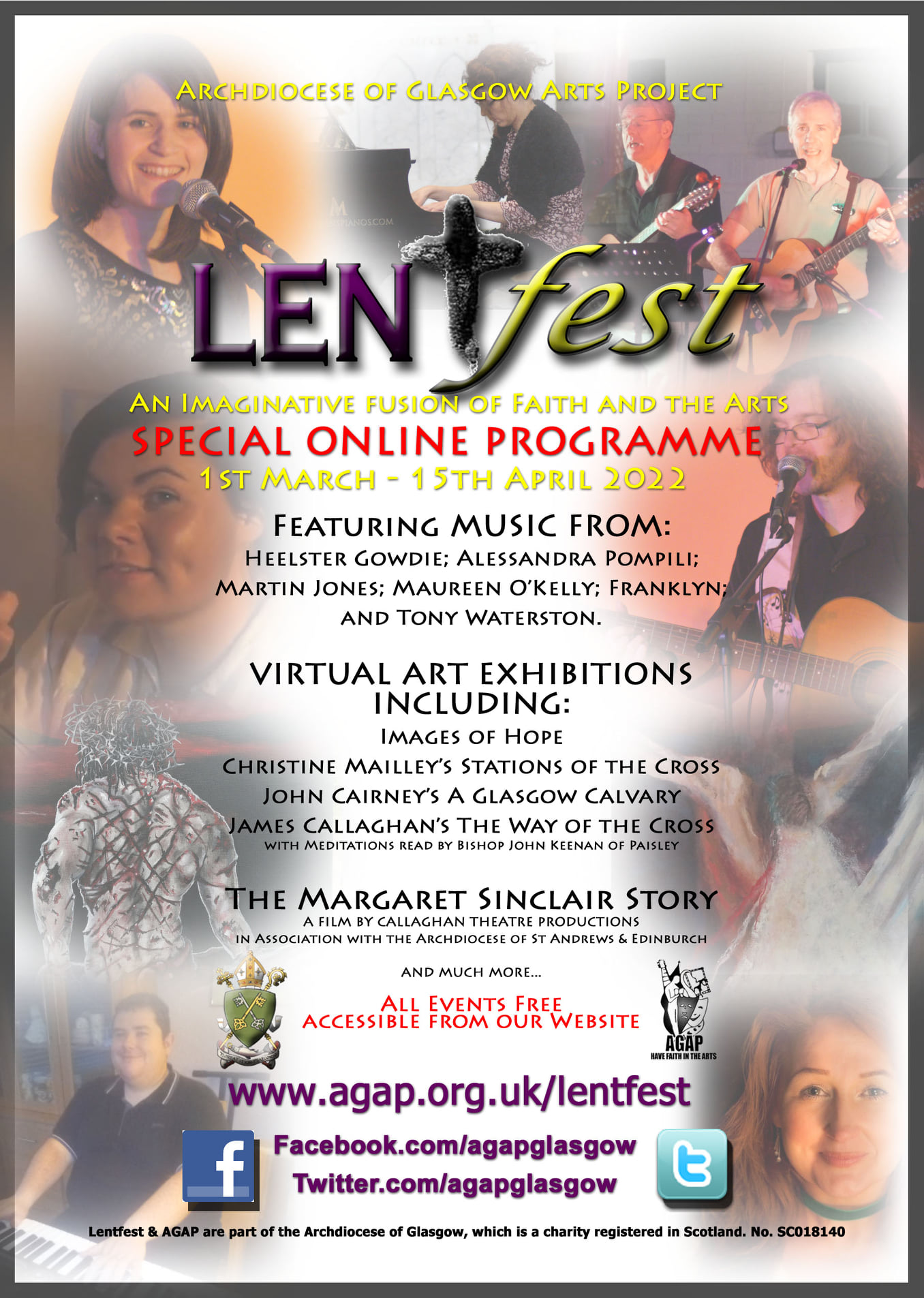
Lentfest 2010 is underway! Following the Mass of Ash Wednesday this year's event was declared open by the Patron of the festival, Archbishop Conti. Among this year's highlight is the touring production of a new drama on the Patron Saint of Priests, St John Vianney...
The life of the 19th Century French priest takes on a new twist when it is told by the Devil in 21st Century Glasgow! Join AGAP Theatre for an all-new fast-moving, quirky rendering of the life of the Curé d'Ars leading towards a climactic showdown with the diabolical narrator of the tale.
The play is faithful to the story of the saint and fuses together many favourite anecdotes about his ministry in Ars whilst drawing a strong parallel with issues facing priests today. The production makes use of a contemporary soundtrack and is infused with humour throughout to create an entertaining yet thought-provoking evening for Lent.
Written specially to mark the Year for Priests (June 2009 – June 2010), inaugurated by Pope Benedict XVI in honour of the 150th anniversary of the death of St John Vianney.
For details of venues, booking and other Lentfest events click here (http://www.agap.org.uk/lent) |
| |
| |
|
|
Archbishop Criticises Assisted Suicide Plans |
Archbishop Mario Conti, has criticised Margo MacDonald’s End of Life Assistance Bill by saying it is “wrong in principle” and that “hard cases made bad laws.”
The head of Scotland’s most populous diocese made clear his opposition by stating that “if it is wrong in principle for someone to take their own life ... it is wrong in principle for someone to help them to do so.”
Speaking during the annual Mass for Health Care Workers at Our Lady of Lourdes Church, Cardonald, Archbishop Conti went on to emphasise that “attempted suicide is no longer a criminal offence” but that laws against “assisted suicide should remain…the good of society demands that it be not changed." Adding that "Mercy can be shown in the administration of justice.”
For the full text of the Archbishop's sermon click here. |
| |
| |
|
| |
Address of Pope Benedict XVI to the Bishops of Scotland |
Dear Brother Bishops
I extend a warm welcome to all of you on your ad Limina visit to Rome. I thank you for the kind words that Cardinal Keith Patrick O’Brien has addressed to me on your behalf, and I assure you of my constant prayers for you and for the faithful entrusted to your care. Your presence here expresses a reality that lies at the heart of every Catholic diocese – its relationship of communio with the See of Peter, and hence with the universal Church. Pastoral initiatives that take due account of this essential dimension bring authentic renewal: when the bonds of communion with the universal Church, and in particular with Rome, are accepted joyfully and lived fully, the people’s faith can grow freely and yield a harvest of good works.
It is a happy coincidence that the Year for Priests, which the whole Church is currently celebrating, marks the four hundredth anniversary of the priestly ordination of the great Scottish martyr Saint John Ogilvie. Rightly venerated as a faithful servant of the Gospel, he was truly outstanding in his dedication to a difficult and dangerous pastoral ministry, to the point of laying down his life. Hold him up as an example for your priests today. I am glad to know of the emphasis you place on continuing formation for your clergy, especially through the initiative “Priests for Scotland”. The witness of priests who are genuinely committed to prayer and joyful in their ministry bears fruit not only in the spiritual lives of the faithful, but also in new vocations. Remember, though, that your commendable initiatives to promote vocations must be accompanied by sustained catechesis among the faithful about the true meaning of priesthood.
Emphasize the indispensable role of the priest in the Church’s life, above all in providing the Eucharist by which the Church herself receives life. And encourage those entrusted with the formation of seminarians to do all they can to prepare a new generation of committed and zealous priests, well equipped humanly, academically and spiritually for the task of ministry in the twenty-first century.
Hand in hand with a proper appreciation of the priest’s role is a correct understanding of the specific vocation of the laity. Sometimes a tendency to confuse lay apostolate with lay ministry has led to an inward-looking concept of their ecclesial role. Yet the Second Vatican Council’s vision is that wherever the lay faithful live out their baptismal vocation – in the family, at home, at work – they are actively participating in the Church’s mission to sanctify the world.
A renewed focus on lay apostolate will help to clarify the roles of clergy and laity and so give strong impetus to the task of evangelizing society.
That task requires a readiness to grapple firmly with the challenges presented by the increasing tide of secularism in your country. Support for euthanasia strikes at the very heart of the Christian understanding of the dignity of human life. Recent developments in medical ethics and some of the practices advocated in the field of embryology give cause for great concern. If the Church’s teaching is compromised, even slightly, in one such area, then it becomes hard to defend the fullness of Catholic doctrine in an integral manner. Pastors of the Church, therefore, must continually call the faithful to complete fidelity to the Church’s Magisterium, while at the same time upholding and defending the Church’s right to live freely in society according to her beliefs.
The Church offers the world a positive and inspiring vision of human life, the beauty of marriage and the joy of parenthood. It is rooted in God’s infinite, transforming and ennobling love for all of us, which opens our eyes to recognize and love his image in our neighbour (cf. Deus Caritas Est, 10-11 et passim). Be sure to present this teaching in such a way that it is recognized for the message of hope that it is. All too often the Church’s doctrine is perceived as a series of prohibitions and retrograde positions, whereas the reality, as we know, is that it is creative and life-giving, and it is directed towards the fullest possible realization of the great potential for good and for happiness that God has implanted within every one of us.
The Church in your country, like many in Northern Europe, has suffered the tragedy of division. It is sobering to recall the great rupture with Scotland’s Catholic past that occurred four hundred and fifty years ago. I give thanks to God for the progress that has been made in healing the wounds that were the legacy of that period, especially the sectarianism that has continued to rear its head even in recent times. Through your participation in Action of Churches Together in Scotland, see that the work of rebuilding unity among the followers of Christ is carried forward with constancy and commitment. While resisting any pressure to dilute the Christian message, set your sights on the goal of full, visible unity, for nothing less can respond to the will of Christ.
You can be proud of the contribution made by Scotland’s Catholic schools in overcoming sectarianism and building good relations between communities. Faith schools are a powerful force for social cohesion, and when the occasion arises, you do well to underline this point. As you encourage Catholic teachers in their work, place special emphasis on the quality and depth of religious education, so as to prepare an articulate and well-informed Catholic laity, able and willing to carry out its mission “by engaging in temporal affairs and by ordering them according to the plan of God” (Christifideles Laici, 15). A strong Catholic presence in the media, local and national politics, the judiciary, the professions and the universities can only serve to enrich Scotland’s national life, as people of faith bear witness to the truth, especially when that truth is called into question.
Later this year, I shall have the joy of being present with you and the Catholics of Scotland on your native soil.
As you prepare for the Apostolic Visit, encourage your people to pray that it will be a time of grace for the whole Catholic community. Take the opportunity to deepen their faith and to rekindle their commitment to bear witness to the Gospel. Like the monks from Iona who spread the Christian message throughout the length and breadth of Scotland, let them be beacons of faith and holiness for the Scottish people today.
With these thoughts, I commend your apostolic labours to the intercession of Our Lady, Saint Andrew, Saint Margaret and all the saints of Scotland. To all of you, and to your clergy, religious and lay faithful I cordially impart my Apostolic Blessing as a pledge of peace and joy in the Lord Jesus Christ. |
| |
| |
|
| |
| Archbishop to receive Honorary Doctorate from Glasgow University |
Archbishop Conti is to receive an Honorary Doctorate of Divinity from the University of Glasgow this summer.
The award is in recognition of his significant contribution to the life of the University through his preaching, support of the Catholic Chaplaincy and the Faculty of Education and the development of Inter Faith Relations. The award also recognises Archbishop Conti’s work with the ecumenical movement as President of Churches Together in Britain and Ireland and as an active member of the Pontifical Council for the Promotion of Christian Unity.
Born in Elgin in 1934, Archbishop Conti studied at the Gregorian University in Rome before being ordained in 1958. After working as an Assistant Priest at St Mary’s Cathedral, Aberdeen, he was appointed Parish Priest of St Joachim’s, Wick and St Anne’s in Thurso in 1962. Nominated Bishop of Aberdeen in 1977, he was appointed Archbishop of Glasgow by His Holiness Pope John Paul II in 2002. He is also an Honorary Professor of Theology at the University of Aberdeen and a Fellow of the Royal Society of Edinburgh.
Also honoured is Glasgow graduate, Rev Kathy Galloway who will receive an Honorary Degree in recognition of 40 years of academic and professional work in the fields of social justice, inter-religious learning, media and the creative arts and to the ecumenical movement.
Clerk of Senate & Vice Principal of the University of Glasgow, Graham Caie said: “The University is delighted to award Doctor of Divinity Honorary Degrees to Archbishop Conti and Rev Kathy Galloway in recognition of their contribution to the ecumenical life of Scotland and their close ties to the University of Glasgow.”
Archbishop Conti said: “I am very honoured to receive this degree and I am grateful to the University authorities."
The Honorary Degrees will be awarded at a ceremony in the Bute Hall at the University of Glasgow in June 2010. |
| |
| |
|
| |
| Are you interested in becoming a member of the Catholic Church? |
To be baptised, confirmed and come to share in the Eucharist is possible at any age! Today, men and women from a variety of backgrounds are responding to the call to follow Christ and celebrate the Sacraments of the Church.
Before sharing in the sacramental life of the Church, you will embark on a journey where you will get to know Christ better and deepen your relationship with him, which could change your life forever.
On the journey, you will meet people who are seeking Christ in their lives, like yourself, and finding the way to answer his call. You will meet other Christians who are witnessing to their faith, to the teachings of Christ and his Church. The whole parish community journeys with you and supports you with prayer as you prepare to be welcomed into the worshipping community.
In the Archdiocese of Glasgow, there are 99 Catholic parishes. Those who are interested in becoming Catholic should, in the first instance, make contact with their local Parish Priest. Every parish should have a programme for adults who are interested in becoming Catholic, called the Rite of Christian Initiation of Adults (RCIA). The starting point for becoming a member of the Catholic Church is simply talking to your local Parish Priest, who will be happy to talk you through the process. He should be able to listen to you and understand what God seems to be doing in your life. The Parish Priest can then introduce you to the basic steps towards becoming Catholic. |
| |
| |
SAINT ANDREW’S CATHEDRAL
TEMPORARY CLOSURE
Until further notice, Mass will be celebrated in Eyre Hall at the Curial Offices, 196 Clyde Street, at the following times:
Sunday 10.00am and 12noon
Monday to Friday 8.15am |
|
During the closure of the Cathedral weekday lunchtime Masses are celebrated at the following city centre churches:
Saint Mary's Pro-Cathedral, Abercromby St 12.15 pm
Saint Mungo's, Parson St, Townhead 12.15 pm
Saint Aloysius, Rose St, Garnethill 12.30 pm
Saint Alphonsus, London Road 12.30 pm
For information on weekday Masses in your local area, please click the "Parishes" icon on the left hand side of the screen and then click on "Parish List". |
| |
| |
|
|
|
|
|